
nicquit.com.au

April 17, 2026

a different way forward

A Different Way Forward – NicQuit Australia

Rethinking Smoking Cessation in Western Australia For years, quitting smoking has been framed as a single moment — a clean break, a final cigarette, a hard line in the sand. But for many people, that version of quitting doesn’t reflect reality. Change rarely happens all at once. More often, it happens in steps. In Western Australia, a growing number of smokers are embracing a different approach — one built on gradual progress, informed choices, and practical support. Instead of focusing solely on stopping, the focus is shifting toward transitioning. And for some, that transition includes vaping.   Moving Beyond “All or Nothing” The idea that quitting must be immediate can make the goal feel overwhelming. Nicotine dependence is not just physical — it’s behavioural, emotional, and deeply routine-based.  That’s why alternatives have become an important part of the conversation. Rather than relying on willpower alone, people are exploring methods that allow them to reduce harm while working toward long-term change.  Vaping, when used appropriately, fits into this space. It offers a way to step away from combustible tobacco — the primary source of smoking-related harm — while still addressing nicotine cravings in a controlled manner.   What Makes Vaping Different? Traditional cigarettes rely on burning tobacco, producing smoke filled with toxic chemicals. Vaping devices, by contrast, heat a liquid to create an aerosol — eliminating combustion.   This distinction matters. How to quit smoking?  Without combustion, exposure to substances like tar and carbon monoxide is significantly reduced. While vaping is not risk-free, it is widely considered a less harmful alternative for adult smokers who have not succeeded with other quitting methods.  Just as important, vaping allows users to manage their nicotine intake more precisely — an option that can support gradual reduction over time.   Why Some Smokers Make the Switch Every quitting journey is personal, but a few common reasons explain why vaping has become part of that process for many:  A gradual pathway Instead of stopping abruptly, users can reduce nicotine levels step by step, making the transition more manageable. A familiar routine The physical habits associated with smoking — holding, inhaling, pausing — are often difficult to break. Vaping can replicate aspects of that routine while removing combustion. A shift in environment Without smoke, ash, or lingering odour, many people find it easier to separate themselves from the identity and lifestyle tied to smoking. A sense of progress Small changes add up. For some, switching completely from cigarettes to vaping is the first major milestone in a longer journey toward quitting nicotine altogether. Understanding the Rules in Western Australia Any decision to use vaping as a quitting aid must be grounded in the law — and in Western Australia, regulations are clear. Nicotine vaping products require a prescription from a qualified medical professional. Vape products can only be sold through licensed pharmacies. Disposable vapes are prohibited. These measures are designed to ensure that vaping is used responsibly and for its intended purpose: supporting smoking cessation, not encouraging new use.  Consulting a GP or pharmacist is an essential first step for anyone considering this option.   It’s Not the Destination — It’s a Step Vaping is not meant to replace one dependency with another indefinitely. Its value lies in what it can help people move away from — and what it can help them move toward.  For many, that means:  Reducing nicotine levels over time Building healthier routines Gaining confidence in their ability to change Combined with support systems, lifestyle adjustments, and professional guidance, it can form part of a broader strategy that leads to complete independence from nicotine.   A More Realistic Kind of Progress There’s no single way to quit smoking. For some, it’s immediate. For others, it’s gradual. What matters is movement in the right direction.  Choosing a structured, regulated alternative doesn’t mean giving up — it means adapting. It means finding a method that works with your life, not against it.  Each step away from cigarettes is a step toward better health. And whether that step is small or significant, it still counts.   If You’re Considering a Change Speak with a healthcare professional before starting any vaping product Use only legally approved and pharmacy-supplied devices Treat vaping as a temporary tool, not a permanent solution Change doesn’t always begin with a dramatic moment. Sometimes, it starts with a decision to try something different — something more manageable, more sustainable, and more aligned with your goals.  And over time, those decisions can lead somewhere powerful: a life no longer shaped by cigarettes.   Written and published by NicQuit.com.au — helping Australians breathe easier, live longer, and quit for good. Copyright ©

A Different Way Forward – NicQuit Australia Read More »

when quitting isn't clean

When Quitting Isn’t Clean – NicQuit Australia

What it actually looks like to walk away from smoking in Australia No one really talks about the awkward middle part. Not the moment you quit. Not the success story a year later. The bit in between—when you’re trying, slipping, trying again, cutting down, bargaining with yourself, and wondering if you’re just going in circles. That’s where most smokers actually live. You’ll hear people say, “Just quit,” but not many ask, “How did you quit smoking?” But if it were that simple, cigarettes wouldn’t still be everywhere. Some people do quit overnight. Good for them. A lot don’t. And pretending otherwise doesn’t help.   The shift that’s quietly happening Something changed in Australia over the last couple of years. Not loudly, not perfectly—but noticeably. The conversation moved away from “you must stop immediately” to something more realistic: What if the goal is still quitting… but the path isn’t all-or-nothing? That’s where vaping entered the picture—not as a miracle fix, and definitely not as something risk-free—but as something in between. A step down from cigarettes, not a final destination. And for some people, that difference matters more than it sounds on paper.   What it actually feels like (for some people) It’s not about flavours or devices or any of that marketing noise. It’s more like this: You’re used to stepping outside every couple of hours. Used to the inhale, the pause, the mental reset. Take that away completely, and it’s not just nicotine you lose—it’s routine. That’s where vaping makes sense to some smokers. Not because it’s “cool,” but because it keeps part of the ritual while removing the burning tobacco—the part doing most of the damage. No ash. No lingering smoke. No coughing fit after a laugh. Is it harmless? No. But compared to lighting something on fire and inhaling it ten times a day, it’s a different category of risk entirely.   The part people get wrong A lot of people treat vaping like a replacement. That’s where things go sideways. It was never meant to be something you settle into permanently. At least, not in the way cigarettes were. The people who actually get somewhere with it tend to treat it like a phase: Start with higher nicotine Gradually bring it down Eventually… stop needing it That part doesn’t happen automatically. It takes intention. Without that, it just becomes a different habit of wearing a cleaner shirt.   The rules aren’t the same everywhere (and that trips people up) This is where it gets confusing—and where a lot of people accidentally do the wrong thing. Australia doesn’t treat vaping like a free-for-all anymore. Not even close. At a national level, things tightened up a lot: You can’t just walk into a vape shop and buy one anymore Everything has been pushed into pharmacies Products are restricted (ingredients, nicotine levels, packaging) But here’s the part most people don’t realise: The prescription rules change depending on the state you’re in.   So what actually applies to you? It’s messy, but here’s the real picture as of now: In Western Australia and Tasmania, you must have a prescription for any vape. It doesn’t matter what the nicotine strength is. In places like NSW, Victoria, Queensland, ACT, and NT, it’s a bit different: If the nicotine is 20 mg/mL or lower, adults can access it through a pharmacy without a prescription—but only after speaking with the pharmacist. Anything above 20 mg/mL still requires a prescription everywhere. Under 18? Prescription required (and in some states, not allowed at all). And across the whole country: You won’t find legal sales in convenience stores anymore Everything is pharmacy-controlled now Why is it set up like this It’s not random. The government basically tried to do two things at once: Stop kids and non-smokers from picking it up casually Still allow smokers access—but through a controlled, medical pathway That’s why pharmacists are involved. That’s why prescriptions still exist in some states. It’s less about convenience now, more about accountability.   The part no law can do for you. Even with all these rules, none of them actually makes someone quit. You can have the “right” device, the legal access, the prescription—whatever applies—and still end up stuck if you’re not actively trying to move forward. The people who get out of smoking don’t just switch. They adjust. Slowly. They notice when they’re reaching for it out of habit instead of need. They start spacing it out. They lower the nicotine. They mess up sometimes. Then keep going. It’s not clean. It’s not linear. But it’s real.   A quick, no-BS summary of the laws If you just want the short version without the noise: All vapes in Australia are pharmacy-only now WA & Tasmania: prescription required for everything Other states: ≤20 mg nicotine → possible without prescription (through pharmacist) 20 mg → prescription required Under 18 → heavily restricted or not allowed Disposable / retail-style sales → essentially gone or banned That’s the landscape.   Where that leaves you If you’re still smoking, you don’t need a perfect plan. Most people don’t start with one. You just need something that moves you away from cigarettes—even slightly. For some, that’s patches or gum. For others, it’s vaping under the right conditions. Not forever. Just long enough to loosen the grip. Because the real goal isn’t switching habits—it’s getting to the point where you don’t need either. And that part? It doesn’t happen overnight. It happens step-by-step.   Written and published by NicQuit.com.au — helping Australians breathe easier, live longer, and quit for good. Copyright ©

When Quitting Isn’t Clean – NicQuit Australia Read More »

clearing the air

Clearing the Air – NicQuit Australia

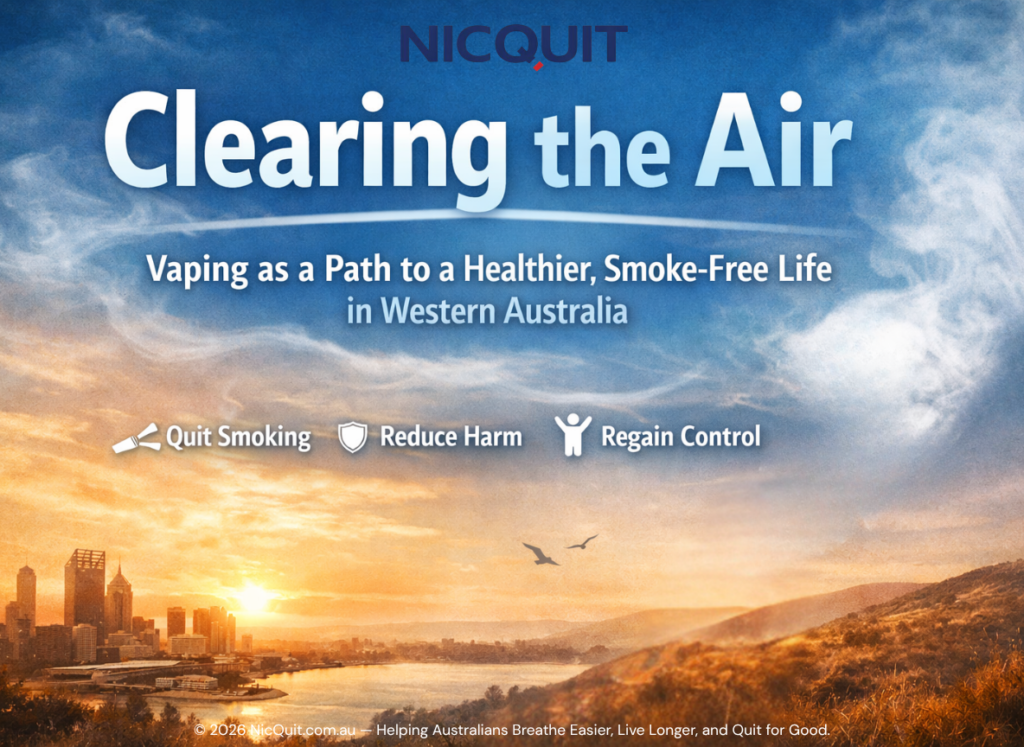
April 17, 2026 Why Vaping Can Be a Step Toward a Healthier, Smoke-Free Life in Western Australia For many Australians, quitting cigarettes isn’t just a health goal — it’s a fight to reclaim control. Smoking rarely exists in isolation. It attaches itself to routines: the first cigarette with coffee, the one after meals, the one during stress. Over time, it becomes less about choice and more about pattern. That’s what makes quitting difficult. It’s not just removing nicotine — it’s disrupting something that has been repeated daily, often for years. Yet more people are starting to push back against that cycle. Not perfectly, not all at once, but deliberately. And for some, vaping has become part of that transition — not as a cure, but as a step that makes the process feel more manageable.   The Harsh Truth About Cigarettes Traditional smoking remains one of the leading causes of preventable death in Australia. Each cigarette produces thousands of chemicals through combustion — including tar and carbon monoxide, which are directly linked to long-term damage. What often gets overlooked is how gradual that damage feels. It builds quietly — reduced stamina, persistent coughing, fatigue — until it becomes harder to ignore. For years, quitting was framed as a matter of willpower. In reality, most people don’t fail because they lack discipline. They struggle because they’re trying to break both a chemical dependency and a deeply embedded routine at the same time.   Vaping: A Bridge, Not a Crutch Vaping changes one key variable: combustion. Instead of burning tobacco, it heats a liquid into vapour. That shift removes many of the harmful byproducts associated with smoking. It does not make vaping harmless. Nicotine remains addictive, and there are still unknowns around long-term use. But for smokers, the decision is often not between “safe” and “unsafe.” It is between continuing a known harmful habit or moving toward something that reduces exposure while they work on quitting entirely.  NicQuit reflects this approach: vaping is not positioned as an endpoint, but as a controlled step. For people who have tried and relapsed, sometimes repeatedly, having a middle ground can make the difference between giving up and trying again with a better strategy.   The Pros of Vaping for Smokers Ready to Quit Reduced HarmRemoving combustion reduces exposure to many of the most damaging chemicals found in cigarette smoke. Some individuals notice gradual improvements in breathing and endurance after switching, though results vary. Controlled NicotineOne of the more practical advantages is control. Smokers often consume nicotine in fixed amounts through cigarettes. Vaping allows adjustment — not just in quantity, but in timing. That flexibility can help shift usage from automatic to intentional. No Smoke ResidueThe absence of smoke changes more than just health exposure. It removes the smell, the residue, and the lingering effects that often reinforce the habit socially and environmentally. Personalisation and SupportNot every smoker has the same triggers. Some struggle most in the morning, others during stress or late at night. Vaping allows adjustments around those moments. With support from NicQuit, this process becomes less about trial and error and more about structured reduction. The Cons and Cautions Vaping is not without risk. It maintains nicotine dependence, and some users experience throat or lung irritation. Long-term effects are still being studied, which means uncertainty remains part of the equation. There is also a practical risk that often gets underestimated: product quality. Unregulated or black-market products may contain inconsistent ingredients or contaminants. This introduces variables that users cannot easily assess on their own. NicQuit addresses this by focusing on transparency, ingredient awareness, and alignment with Australian regulations. That structure matters, because without it, many users are left guessing — how much nicotine they are using, whether it is compliant, and whether it is safe to continue.   The Law in Western Australia Western Australia has taken a stricter approach than most jurisdictions. Vaping products are limited to registered pharmacies, and nicotine vapes require a prescription. This framework changes how people access vaping. It removes convenience, but replaces it with oversight. The intent is not to encourage widespread use, but to ensure that when vaping is used, it is done within a controlled and regulated setting. Disposable vapes are banned, reinforcing the idea that vaping is not meant to be casual or disposable, but deliberate and temporary.   The End Goal: Freedom, Not Substitution Not everyone who switches to vaping quits nicotine immediately. Some reduce gradually. Others plateau. A few return to cigarettes before trying again. That pattern is more common than people admit. Quitting is rarely linear. What tends to make a difference is structure. Starting with a certain nicotine level, identifying trigger moments, then reducing over time with a clear plan. With guidance and support from NicQuit, that process becomes more intentional rather than reactive. The goal is not to replace one dependency with another, but to create distance from the most harmful form first — and then continue reducing until dependence is no longer necessary.   A Message to Those Still Trying Most people who quit smoking do not succeed on their first attempt. That does not mean the effort failed — it means they are still in the process of learning what works. Progress often looks small: delaying a cigarette, replacing one habit, reducing frequency. Over time, those small shifts compound. Vaping can be part of that process when used with clear intent. Not as a fallback, but as a controlled step forward. Because quitting is not a single decision. It is a series of adjustments that gradually move you away from dependence and toward control.   If You Live in Western Australia Speak to a GP or qualified health professional before starting vaping Purchase products only from registered pharmacies Approach vaping as a temporary step, not a permanent solution Change does not happen overnight, but every step away from cigarettes is a step toward clarity, strength, and control. Choose progress, stay consistent, and give yourself the chance to breathe easier,

Clearing the Air – NicQuit Australia Read More »