nicquit.com.au

Articles

Traveler presenting passport at Australian airport, showing vaping laws in Australia for tourists and entry restrictions

Crossing the Line: Vaping Laws in Australia for Tourists and Smokers – NicQuit Australia

What smokers and vapers need to know before entering Australia For many travelers, arriving in Australia feels simple. Passport. Luggage. Maybe a few personal items that make the trip more comfortable. But if you smoke—or use vapes—the moment you step into Australia, things change faster than most people expect. Because here, it’s not just about what you use.It’s about how it entered the country, why you’re using it, and whether the law allows it at all. And unlike some countries where rules are loose or inconsistently enforced, Australia treats this seriously—from the airport to the pharmacy, and especially in places like Western Australia. The moment you land Everything begins at the border. Australia doesn’t treat vapes or tobacco like everyday items. In many cases, they’re classified as controlled or restricted imports, which means bringing them in—even for personal use—can be regulated or limited.  For vaping products, the rules tightened significantly starting in 2024. Most vaping products are now considered prohibited imports unless strict conditions are met  The old system that allowed individuals to freely import vapes for personal use has been removed What’s left is a narrow exception. The “traveler’s exemption” (and its limits) If you’re entering Australia as a visitor and you vape, you’re not completely banned—but you’re heavily restricted. Under current rules: You can only bring a small, limited quantity of vapes Typically: Up to 2 vape devices Limited accessories (like pods or cartridges) Small volumes of liquid But the most important detail isn’t the quantity. It’s the purpose. Those vapes must be: For personal therapeutic use, not casual or recreational use And if they contain nicotine: You generally need a valid prescription, even as a tourist That’s the part that surprises people. In many countries, nicotine vapes are sold like consumer products.In Australia, they’re treated more like medical tools. Cigarettes are different—but not unrestricted Unlike vapes, cigarettes don’t require a prescription. But that doesn’t mean they’re unregulated. Australia has long-standing tobacco import rules, and most tobacco products are still classified as controlled imports, especially in larger quantities. Travelers can bring limited amounts for personal use, but anything beyond that can trigger: Duties Taxes Or even confiscation Once inside the country, cigarettes are legal for adult use—but heavily controlled. What applies once you’re inside Australia Here’s where many visitors get caught off guard. Even if you legally bring cigarettes or vapes into Australia, how and where you use them is strictly regulated. Across the country: Smoking is banned in enclosed public places, workplaces, public transport, and many outdoor areas. These rules often apply to vaping as well You can’t: Vape or smoke inside restaurants Use them in public transport Or light up in most shared indoor environments And yes—this includes tourists. The law doesn’t distinguish between residents and visitors when it comes to public health protections. Western Australia — where rules tighten further If you’re heading to Western Australia, the system becomes even stricter. This is one of the most tightly regulated regions in the country when it comes to vaping. According to the WA Department of Health: All nicotine vapes require a prescription, regardless of strength  Pharmacies cannot supply nicotine vapes without one That means: Even if you legally enter Australia with a vape,you cannot legally purchase or continue using nicotine vaping products in WA without proper medical approval. There’s no “tourist exception” once you’re inside the state. Other states — slightly more flexible, but still controlled Outside WA, the system varies slightly. In states like: New South Wales Victoria Queensland There has been movement toward allowing: Low-strength nicotine vapes (≤20 mg/mL) Access through pharmacies, sometimes without a prescription (depending on timing and implementation) But even here: Higher nicotine levels still require prescriptions Retail sales outside pharmacies are banned Products must meet strict national standards So while access might be easier in some states, it’s still far from unrestricted. Where people make mistakes The biggest problems for travelers don’t come from intentional rule-breaking. They come from assumptions. Assuming that: What’s legal at home is legal in Australia A vape in your bag is no different from a phone or charger Buying one locally will be easy None of that holds true here. Common mistakes include: Bringing multiple disposable vapes Carrying nicotine liquids without a prescription Trying to buy from convenience stores (which are no longer allowed to sell them) Using vapes in restricted public areas In some cases, this leads to confiscation.In others, fines. Even the plane ride matters The rules don’t just apply on the ground. In Australia: Smoking and vaping are strictly prohibited on all flights Violations can result in fines of around $2,500 or more  You can carry vape devices in your hand luggage (for safety reasons), but: You cannot use them You cannot charge them mid-flight It’s a small detail—but one that catches people off guard. Why Australia takes this approach At first glance, it can feel excessive. Why so many rules for something that’s legal in other countries? The answer comes down to public health. Australia has spent decades reducing smoking rates through: High taxation Advertising bans Strict public-use laws And it’s applying that same mindset to vaping. The concern isn’t just smokers—it’s: Youth uptake Unregulated products Long-term health impacts So the system is designed to: Allow access only when necessary Prevent casual or widespread use Keep everything within a controlled medical or regulatory framework What travelers should actually do If you’re planning to visit Australia and you smoke or vape, the safest approach is simple: Bring minimal quantities only Avoid disposable vapes altogether where possible If using nicotine vapes, have a valid prescription ready Expect stricter rules in Western Australia Use only in designated or permitted areas And most importantly: Don’t assume you can replace what you bring. Buying locally isn’t straightforward anymore. The bigger picture For visitors, these rules can feel restrictive. But they’re part of a broader system that’s trying to manage something difficult: How to allow access for people who rely on nicotine—without creating a new wave

Crossing the Line: Vaping Laws in Australia for Tourists and Smokers – NicQuit Australia Read More »

Vaping vs smoking comparison showing health risk differences

Vaping vs Smoking: Facts, Risks & Myths- NicQuit Australia

Vaping vs Smoking: Separating Fact from Fiction Public understanding of vaping has become increasingly unclear. Many people now believe that vaping is as harmful as—or even more harmful than—smoking. Current evidence does not support this view. In countries such as the United Kingdom, where vaping has been regulated and studied for many years, health authorities have taken an evidence-based approach. This article addresses common misconceptions and highlights important safety considerations, including the role of regulated products and proper device use. Is Vaping as Harmful as Smoking? No. While vaping is not risk-free, it is widely recognized as significantly less harmful than smoking. Cigarettes burn tobacco, releasing thousands of harmful chemicals, including tar and carbon monoxide. These substances are responsible for most smoking-related diseases, including cancer, heart disease, and chronic lung conditions. Vaping does not involve combustion. Instead, it heats a liquid to produce an aerosol, resulting in substantially lower exposure to toxic substances. UK health authorities, including those referenced by the National Health Service (NHS), have consistently stated that vaping exposes users to a fraction of the risks associated with smoking. Does Vaping Cause the Same Diseases as Smoking? There is currently no strong evidence to suggest that vaping carries the same level of disease risk as smoking. Smoking-related illnesses are largely driven by long-term exposure to toxic smoke from burning tobacco. Vaping products do not produce this smoke and generally contain fewer harmful chemicals at lower levels. Although long-term data on vaping continues to develop, current evidence indicates that the health risks are significantly lower than those associated with smoking. Is Vaping Supported as a Quit-Smoking Tool? In the UK, vaping is widely used as part of smoking cessation strategies. Health services recognize that quitting smoking can be difficult. Vaping provides a controlled source of nicotine while avoiding many of the harmful by-products of combustion. Many smokers have successfully transitioned away from cigarettes using vaping, particularly when combined with behavioral support. Is Vaping Safe? No. Vaping is not considered completely safe. Most products contain nicotine, which is addictive. While harmful substances are present at lower levels than in cigarettes, they are not absent. The long-term effects are still being studied. For this reason, vaping is intended for smokers attempting to quit—not for non-smokers or young people. The Importance of Regulated Vape Products A critical but often overlooked factor is the type of vaping product being used. Regulated products are subject to quality and safety standards. These controls help ensure consistent nicotine delivery and limit exposure to harmful or unknown substances. In contrast, non-prescription or unregulated vape liquids may: Contains inconsistent nicotine levels Include unapproved or poorly tested ingredients Manufactured without proper quality control Using such products can reduce the potential benefits of switching from smoking and may introduce unnecessary risks. Flavors and Formulations: What Is Allowed In regulated environments, only a limited range of vape liquid formulations is typically permitted. These are designed to support smoking cessation while reducing unnecessary appeal. Commonly allowed options include: Unflavored liquids Tobacco-flavored liquids Mint or menthol variants within regulatory definitions Highly sweet or novelty flavors are often restricted due to concerns around youth uptake and uncertain long-term safety. Using approved formulations supports a more controlled and consistent approach to smoking cessation. Device Modification and User Safety Another important but less discussed issue is how vaping devices are used in practice. Many modern vape devices allow for a degree of customization, including: Changing coils (the heating element) Replacing or adjusting cotton or wicking materials Modifying power settings or airflow While these features can improve user experience when done correctly, improper modification or use can increase potential risks. For example: Incorrect coil installation may lead to overheating Poor-quality or incompatible materials may produce unwanted by-products when heated Excessive power settings can cause liquids to degrade at higher temperatures Improper wicking can result in “dry hits,” which may expose users to harsher compounds These issues are more likely to occur with unregulated devices or when components are altered without proper knowledge or guidance. Using devices as intended by the manufacturer, along with regulated components and liquids, helps minimize these risks and ensures more consistent nicotine delivery. Why Do Misconceptions Persist? Despite growing evidence, many people believe that vaping is as harmful as smoking. These can be influenced by messages that highlight risks without clearly explaining the difference in relative harm. As a result, some smokers may assume there is little benefit in switching. Research from the UK has shown that a significant number of smokers now hold incorrect beliefs about vaping. This misunderstanding may discourage attempts to quit smoking. Diverse Strategies: UK and Australia The United Kingdom has adopted a harm-reduction approach. Vaping products are regulated and, in some cases, integrated into smoking cessation programs. Public messaging emphasizes that vaping is less harmful than smoking, while still acknowledging risks. Australia has taken a more restrictive approach, often placing stronger emphasis on potential harms. While intended to reduce uptake, this approach may also contribute to confusion about relative risk. Restrictions alone have not eliminated youth vaping, and misconceptions among smokers remain common. Culmination The current evidence supports several clear conclusions: Smoking remains one of the most harmful behaviors for long-term health Vaping is not risk-free, but it is significantly less harmful than smoking The use of regulated products is essential to minimize risk Unregulated liquids and improper device use may introduce avoidable harm The most effective outcome remains complete cessation of nicotine use For smokers who are unable to quit immediately, switching to properly regulated vaping products—used as intended—may reduce exposure to harmful chemicals and support the transition away from cigarettes. Accurate, balanced information is essential. Misunderstanding both the relative risks and the importance of proper product use can prevent individuals from making informed decisions about their health. Sources NHS – Vaping myths and facts NHS – Using e-cigarettes to stop smoking UK Government – E-cigarettes evidence review Action on Smoking and Health (ASH UK) – Vaping guidance Cancer Research UK – Is vaping harmful? UCL

Vaping vs Smoking: Facts, Risks & Myths- NicQuit Australia Read More »

People walking outside a courthouse building, reflecting Australian government regulation and public health policy on smoking and vaping

Guardrails, Not Just Rules – NicQuit Australia

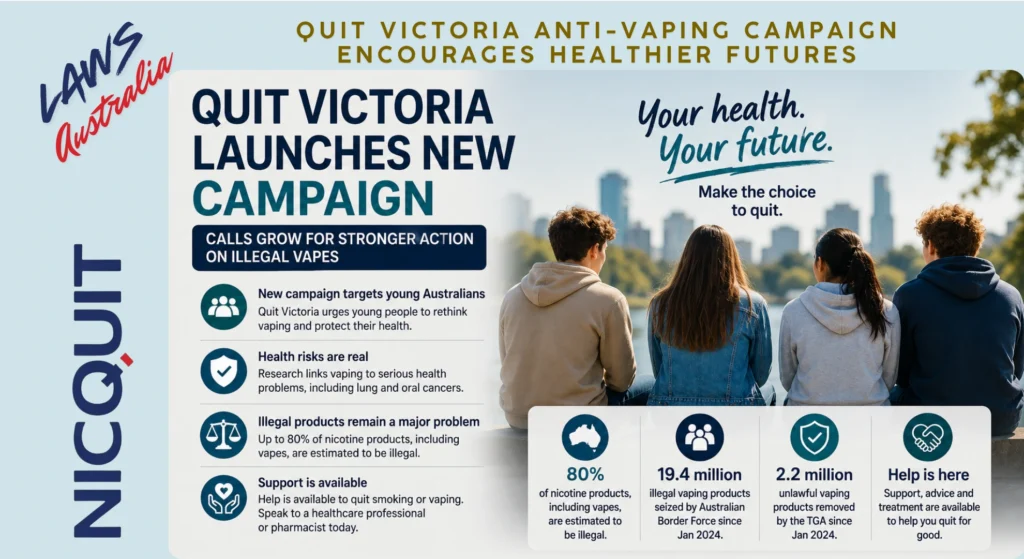
How Australian Governments Are Trying to Protect Smokers—and Those Trying to Quit If you look at smoking and vaping in Australia from the outside, it can feel confusing. One year, you hear that vaping might help people quit. Next, you hear about bans, crackdowns, and stricter controls. It can seem like mixed messages. But underneath all of that, there’s a pattern—a deliberate one.   Different government bodies—federal, state, and local—are all pulling in the same direction, even if they’re using different tools: Reduce harm. Protect young people. Help smokers quit without opening the door to new addiction.   It’s not perfect. It’s still evolving. But it’s far from random.   The Federal Backbone — Where the Rules Begin At the center of it all is the Australian Government, mainly through the Department of Health and the Therapeutic Goods Administration (TGA). This is where the biggest decisions are made. If you trace most of the major changes—pharmacy-only sales, prescription rules, product standards—back, they start here.   You can see it laid out through the government’s own framework: Australian Government – Vaping Laws Overview   From mid-2024 onward, Australia made a hard shift. Vapes are no longer sold freely in retail stores They’re treated more like therapeutic products, not consumer goods Access is routed through pharmacies and healthcare professionals This wasn’t accidental.   The goal was to draw a clear line: If vaping exists, it exists as a tool for quitting—not as a lifestyle product.   The Therapeutic Goods Administration (TGA) plays a huge role here. They: Set product standards (what can legally be sold) Monitor safety and quality Work with enforcement agencies to remove illegal products   From 2025 onward, even stricter standards kicked in—meaning only approved, compliant vaping products can be supplied through pharmacies. (Therapeutic Goods Administration (TGA))   At the same time, the federal government didn’t just regulate products—they tightened supply chains. Disposable vape imports were banned Retail sales outside pharmacies were shut down Importers now need licenses and approvals (Law Society Journal)   This is the backbone of Australia’s approach: Control what enters the country, control how it’s sold, and control who accesses it.   Enforcement Isn’t Just Talk — It’s Coordinated Rules don’t mean much without enforcement, that’s why the federal system doesn’t operate alone. The TGA works alongside: Australian Border Force State health departments Local compliance units This is not siloed work—it’s coordinated.   You can see that collaboration is clear here: TGA Compliance and Enforcement Overview   Since 2024: Joint operations have been targeting the illegal vape supply Inspections and seizures have increased Authorities are focusing more on suppliers, not individual users That last part matters.   Australia’s approach generally avoids criminalizing individuals for possession. Instead, it targets the commercial side—the people making money from illegal or unsafe products. (Alcohol and Drug Foundation)   It’s a public health strategy, not just a legal one.   Western Australia — One of the Strictest Systems in the Country If you live in Western Australia, the rules feel tighter—and that’s because they are.   The WA Department of Health – Vaping Information makes it very clear: Vapes can only be supplied through registered pharmacies Retailers like vape shops or convenience stores cannot sell them at all (WA Health)   On top of that: A prescription is required for vaping products The state maintains stricter controls than most others   This is backed by broader legislation, like: Tobacco Products Control Act 2006 Medicines and Poisons Act 2014 (WorkSafe WA)   But WA hasn’t stopped at supply control.   They’ve expanded protections into everyday environments.   For example: Vaping is now banned in enclosed workplaces, aligning it with smoking laws (Western Australian Government)   That move wasn’t just symbolic.   It reflects a clear stance: Vaping should not become normalized in public or shared spaces.   The Crackdown on Illegal Supply Another area where WA stands out is enforcement. The state government has been actively targeting the black market—and not lightly.   Recent legislation introduced by the Cook Government includes: Heavy fines (millions of dollars for large-scale offences) Potential prison sentences Temporary closure of businesses selling illegal products (Western Australian Government) These aren’t small penalties. They’re designed to disrupt organized supply chains—because illegal vaping products don’t just bypass regulation, they bypass safety. And that’s where the risk increases.   Other States — Similar Direction, Slightly Different Path While Western Australia and Tasmania have taken a stricter route, other states have adopted a slightly more flexible system.   Across much of Australia: Adults (18+) can access low-nicotine vapes (≤20 mg/mL) through pharmacies This may not require a prescription—but still involves pharmacist consultation (Health and Ageing Department) Anything stronger still requires a prescription.   And across all states: Retail sales outside pharmacies are banned Products must meet national standards Supply is controlled and monitored This creates a kind of layered system. Same national foundation—but with state-level adjustments depending on how strict local governments choose to be.   Why the System Looks This Way From the outside, it can feel overly complicated, But it’s trying to balance something inherently difficult.   Two realities exist at the same time: Smoking is still one of the leading causes of preventable death Vaping introduces its own risks, especially for younger people So governments are walking a narrow line.   They don’t want: Easy access that leads to widespread uptake Or a total ban that removes a potential quitting tool   That’s why vaping is framed as: A controlled option A secondary pathway, not a first-line treatment   Even the TGA reinforces this.   Vaping is not the first recommendation for quitting—methods like patches, gum, and behavioural support still come first. (Therapeutic Goods Administration (TGA))   But for people who haven’t succeeded with those, regulated vaping remains an option.   More Than Laws — It’s About Behaviour Something important often gets lost in policy discussions. No law, no matter how strict, can make someone quit.   It can: Reduce access Improve safety Limit exposure But it

Guardrails, Not Just Rules – NicQuit Australia Read More »

the long way out

The Long Way Out – NicQuit Australia

Some people remember their first cigarette like it meant something. A turning point. A rebellion. A way to fit in, or to cope, or to feel older than they were. What they don’t expect is how quietly it stays. Not loud. Not dramatic. Just there—threaded into everything. Morning coffee. Breaks at work. That walk outside after a long day. It becomes less of a choice and more of a reflex. Something your hands do before your brain even catches up. At first, it feels harmless. Even controlled. You tell yourself it’s occasional. Social. Temporary. You can stop whenever you want. And maybe, at the beginning, that’s true. But habits don’t announce when they’ve taken root. They don’t send a warning when they cross the line from choice to dependence. They settle in. Day by day. Cigarette by cigarette. Until one day, without any clear moment marking the change, it’s part of you. And then one morning, something shifts. It’s not always dramatic. Sometimes it’s barely noticeable. You climb a set of stairs and feel your chest tighten more than it should. You wake up, and your throat feels raw, like you’ve been breathing in something heavy all night. You laugh—really laugh—and it turns into a cough that lingers longer than it used to. Or maybe it’s not physical at all. Maybe it’s the way you plan your day around it. The way you step outside during conversations. The way you feel uneasy when you don’t have a pack on you. That low, constant pull in the background. And somewhere in all of that, a thought shows up: “I don’t think I’m in control of this anymore.” The part no one sees Quitting sounds simple when it’s said out loud. “I’m going to stop.” It feels decisive. Clean. Final. But the reality is nothing like that. The first attempt usually carries a kind of determination. You throw away the pack. You ignore the cravings. You push through the discomfort with the kind of stubbornness that feels like strength. And for a while, it works. A day passes. Then another. Maybe even a week. Then something small happens. Stress builds up at work. You have a drink with friends. You’re bored. Tired. Frustrated. Restless. It doesn’t even have to be a big moment. Just enough to crack the surface. And suddenly, you’re holding a cigarette again. There’s a strange mix of relief and disappointment in that moment. Relief because the craving quiets down. Disappointment because you know exactly what it means. You tell yourself it’s just one. A slip, not a failure. But deep down, it feels heavier than that. Because it wasn’t just about nicotine. It was about everything wrapped around it. The routine. The timing. The pause it gave you in the middle of a day that didn’t slow down on its own. The familiar motion of lighting up, inhaling, exhaling. The way it gave your hands something to do when your mind was too full. So when you try to quit, you’re not just removing a chemical. You’re dismantling a structure that’s been holding pieces of your life together. And that’s why it hurts more than people expect. The middle stretch This is the part that doesn’t get talked about enough. Not the beginning, where motivation is high. Not the end, where everything feels resolved. The middle. Where progress doesn’t feel like progress. Where the line between trying and failing gets blurry. You start making changes. Small ones. You delay your first cigarette of the day. Instead of lighting up right after waking, you wait. Ten minutes. Then twenty. Then maybe an hour. You skip one break. Then another. You tell yourself, just one less today. And sometimes, that’s exactly what happens. Other days, it doesn’t. You have a rough afternoon and end up smoking more than you planned. You get frustrated with yourself. You question whether any of it is working. There’s a kind of exhaustion that comes with this phase. Not physical, but mental. You’re constantly aware of the habit. Constantly negotiating with yourself. “Do I need this right now?” “Can I wait a bit longer?” “What if I just have one?” It’s a quiet battle, but it’s relentless. And it’s easy to feel like you’re stuck. Like you’re circling the same ground without actually moving forward. But something is happening, even if it doesn’t feel like it. Each delay, each skipped cigarette, each moment where you choose differently—it all adds up. Not in a dramatic way. Not in a way that feels rewarding right away. But it shifts something. Slowly. The weight of habit There’s a reason this process feels so difficult, and it’s not because of a lack of willpower. Smoking isn’t just a habit you picked up. It’s something your brain has adapted to over time. It’s tied to moments—after meals, during breaks, in social settings, in stress. It becomes a kind of shorthand for relief. A signal that says, ” This is when you pause. So when you remove it, there’s a gap. Not just physically, but mentally. You finish eating and feel like something’s missing. You step outside and don’t know what to do with your hands. You go through stress without that familiar release. At first, that gap feels uncomfortable. Sometimes unbearable. You become aware of how often you relied on it, not just for nicotine, but for structure. And replacing that isn’t instant. It takes time to figure out what fills that space in a way that actually works. Some people walk. Some chew gum. Some just sit with the discomfort until it passes. There’s no perfect substitute. Just a gradual process of learning how to exist without it. When something finally shifts There isn’t always a clear turning point. No single moment where everything clicks, and the struggle disappears. It’s quieter than that. You realize, one afternoon, that you haven’t thought about smoking in a few hours. Then it happens again the next day. At first, it feels

The Long Way Out – NicQuit Australia Read More »

a different way forward

A Different Way Forward – NicQuit Australia

Rethinking Smoking Cessation in Western Australia For years, quitting smoking has been framed as a single moment — a clean break, a final cigarette, a hard line in the sand. But for many people, that version of quitting doesn’t reflect reality. Change rarely happens all at once. More often, it happens in steps. In Western Australia, a growing number of smokers are embracing a different approach — one built on gradual progress, informed choices, and practical support. Instead of focusing solely on stopping, the focus is shifting toward transitioning. And for some, that transition includes vaping.   Moving Beyond “All or Nothing” The idea that quitting must be immediate can make the goal feel overwhelming. Nicotine dependence is not just physical — it’s behavioural, emotional, and deeply routine-based.  That’s why alternatives have become an important part of the conversation. Rather than relying on willpower alone, people are exploring methods that allow them to reduce harm while working toward long-term change.  Vaping, when used appropriately, fits into this space. It offers a way to step away from combustible tobacco — the primary source of smoking-related harm — while still addressing nicotine cravings in a controlled manner.   What Makes Vaping Different? Traditional cigarettes rely on burning tobacco, producing smoke filled with toxic chemicals. Vaping devices, by contrast, heat a liquid to create an aerosol — eliminating combustion.   This distinction matters. How to quit smoking?  Without combustion, exposure to substances like tar and carbon monoxide is significantly reduced. While vaping is not risk-free, it is widely considered a less harmful alternative for adult smokers who have not succeeded with other quitting methods.  Just as important, vaping allows users to manage their nicotine intake more precisely — an option that can support gradual reduction over time.   Why Some Smokers Make the Switch Every quitting journey is personal, but a few common reasons explain why vaping has become part of that process for many:  A gradual pathway Instead of stopping abruptly, users can reduce nicotine levels step by step, making the transition more manageable. A familiar routine The physical habits associated with smoking — holding, inhaling, pausing — are often difficult to break. Vaping can replicate aspects of that routine while removing combustion. A shift in environment Without smoke, ash, or lingering odour, many people find it easier to separate themselves from the identity and lifestyle tied to smoking. A sense of progress Small changes add up. For some, switching completely from cigarettes to vaping is the first major milestone in a longer journey toward quitting nicotine altogether. Understanding the Rules in Western Australia Any decision to use vaping as a quitting aid must be grounded in the law — and in Western Australia, regulations are clear. Nicotine vaping products require a prescription from a qualified medical professional. Vape products can only be sold through licensed pharmacies. Disposable vapes are prohibited. These measures are designed to ensure that vaping is used responsibly and for its intended purpose: supporting smoking cessation, not encouraging new use.  Consulting a GP or pharmacist is an essential first step for anyone considering this option.   It’s Not the Destination — It’s a Step Vaping is not meant to replace one dependency with another indefinitely. Its value lies in what it can help people move away from — and what it can help them move toward.  For many, that means:  Reducing nicotine levels over time Building healthier routines Gaining confidence in their ability to change Combined with support systems, lifestyle adjustments, and professional guidance, it can form part of a broader strategy that leads to complete independence from nicotine.   A More Realistic Kind of Progress There’s no single way to quit smoking. For some, it’s immediate. For others, it’s gradual. What matters is movement in the right direction.  Choosing a structured, regulated alternative doesn’t mean giving up — it means adapting. It means finding a method that works with your life, not against it.  Each step away from cigarettes is a step toward better health. And whether that step is small or significant, it still counts.   If You’re Considering a Change Speak with a healthcare professional before starting any vaping product Use only legally approved and pharmacy-supplied devices Treat vaping as a temporary tool, not a permanent solution Change doesn’t always begin with a dramatic moment. Sometimes, it starts with a decision to try something different — something more manageable, more sustainable, and more aligned with your goals.  And over time, those decisions can lead somewhere powerful: a life no longer shaped by cigarettes.   Written and published by NicQuit.com.au — helping Australians breathe easier, live longer, and quit for good. Copyright ©

A Different Way Forward – NicQuit Australia Read More »

when quitting isn't clean

When Quitting Isn’t Clean – NicQuit Australia

What it actually looks like to walk away from smoking in Australia No one really talks about the awkward middle part. Not the moment you quit. Not the success story a year later. The bit in between—when you’re trying, slipping, trying again, cutting down, bargaining with yourself, and wondering if you’re just going in circles. That’s where most smokers actually live. You’ll hear people say, “Just quit,” but not many ask, “How did you quit smoking?” But if it were that simple, cigarettes wouldn’t still be everywhere. Some people do quit overnight. Good for them. A lot don’t. And pretending otherwise doesn’t help.   The shift that’s quietly happening Something changed in Australia over the last couple of years. Not loudly, not perfectly—but noticeably. The conversation moved away from “you must stop immediately” to something more realistic: What if the goal is still quitting… but the path isn’t all-or-nothing? That’s where vaping entered the picture—not as a miracle fix, and definitely not as something risk-free—but as something in between. A step down from cigarettes, not a final destination. And for some people, that difference matters more than it sounds on paper.   What it actually feels like (for some people) It’s not about flavours or devices or any of that marketing noise. It’s more like this: You’re used to stepping outside every couple of hours. Used to the inhale, the pause, the mental reset. Take that away completely, and it’s not just nicotine you lose—it’s routine. That’s where vaping makes sense to some smokers. Not because it’s “cool,” but because it keeps part of the ritual while removing the burning tobacco—the part doing most of the damage. No ash. No lingering smoke. No coughing fit after a laugh. Is it harmless? No. But compared to lighting something on fire and inhaling it ten times a day, it’s a different category of risk entirely.   The part people get wrong A lot of people treat vaping like a replacement. That’s where things go sideways. It was never meant to be something you settle into permanently. At least, not in the way cigarettes were. The people who actually get somewhere with it tend to treat it like a phase: Start with higher nicotine Gradually bring it down Eventually… stop needing it That part doesn’t happen automatically. It takes intention. Without that, it just becomes a different habit of wearing a cleaner shirt.   The rules aren’t the same everywhere (and that trips people up) This is where it gets confusing—and where a lot of people accidentally do the wrong thing. Australia doesn’t treat vaping like a free-for-all anymore. Not even close. At a national level, things tightened up a lot: You can’t just walk into a vape shop and buy one anymore Everything has been pushed into pharmacies Products are restricted (ingredients, nicotine levels, packaging) But here’s the part most people don’t realise: The prescription rules change depending on the state you’re in.   So what actually applies to you? It’s messy, but here’s the real picture as of now: In Western Australia and Tasmania, you must have a prescription for any vape. It doesn’t matter what the nicotine strength is. In places like NSW, Victoria, Queensland, ACT, and NT, it’s a bit different: If the nicotine is 20 mg/mL or lower, adults can access it through a pharmacy without a prescription—but only after speaking with the pharmacist. Anything above 20 mg/mL still requires a prescription everywhere. Under 18? Prescription required (and in some states, not allowed at all). And across the whole country: You won’t find legal sales in convenience stores anymore Everything is pharmacy-controlled now Why is it set up like this It’s not random. The government basically tried to do two things at once: Stop kids and non-smokers from picking it up casually Still allow smokers access—but through a controlled, medical pathway That’s why pharmacists are involved. That’s why prescriptions still exist in some states. It’s less about convenience now, more about accountability.   The part no law can do for you. Even with all these rules, none of them actually makes someone quit. You can have the “right” device, the legal access, the prescription—whatever applies—and still end up stuck if you’re not actively trying to move forward. The people who get out of smoking don’t just switch. They adjust. Slowly. They notice when they’re reaching for it out of habit instead of need. They start spacing it out. They lower the nicotine. They mess up sometimes. Then keep going. It’s not clean. It’s not linear. But it’s real.   A quick, no-BS summary of the laws If you just want the short version without the noise: All vapes in Australia are pharmacy-only now WA & Tasmania: prescription required for everything Other states: ≤20 mg nicotine → possible without prescription (through pharmacist) 20 mg → prescription required Under 18 → heavily restricted or not allowed Disposable / retail-style sales → essentially gone or banned That’s the landscape.   Where that leaves you If you’re still smoking, you don’t need a perfect plan. Most people don’t start with one. You just need something that moves you away from cigarettes—even slightly. For some, that’s patches or gum. For others, it’s vaping under the right conditions. Not forever. Just long enough to loosen the grip. Because the real goal isn’t switching habits—it’s getting to the point where you don’t need either. And that part? It doesn’t happen overnight. It happens step-by-step.   Written and published by NicQuit.com.au — helping Australians breathe easier, live longer, and quit for good. Copyright ©

When Quitting Isn’t Clean – NicQuit Australia Read More »

clearing the air

Clearing the Air – NicQuit Australia

April 17, 2026 Why Vaping Can Be a Step Toward a Healthier, Smoke-Free Life in Western Australia For many Australians, quitting cigarettes isn’t just a health goal — it’s a fight to reclaim control. Smoking rarely exists in isolation. It attaches itself to routines: the first cigarette with coffee, the one after meals, the one during stress. Over time, it becomes less about choice and more about pattern. That’s what makes quitting difficult. It’s not just removing nicotine — it’s disrupting something that has been repeated daily, often for years. Yet more people are starting to push back against that cycle. Not perfectly, not all at once, but deliberately. And for some, vaping has become part of that transition — not as a cure, but as a step that makes the process feel more manageable.   The Harsh Truth About Cigarettes Traditional smoking remains one of the leading causes of preventable death in Australia. Each cigarette produces thousands of chemicals through combustion — including tar and carbon monoxide, which are directly linked to long-term damage. What often gets overlooked is how gradual that damage feels. It builds quietly — reduced stamina, persistent coughing, fatigue — until it becomes harder to ignore. For years, quitting was framed as a matter of willpower. In reality, most people don’t fail because they lack discipline. They struggle because they’re trying to break both a chemical dependency and a deeply embedded routine at the same time.   Vaping: A Bridge, Not a Crutch Vaping changes one key variable: combustion. Instead of burning tobacco, it heats a liquid into vapour. That shift removes many of the harmful byproducts associated with smoking. It does not make vaping harmless. Nicotine remains addictive, and there are still unknowns around long-term use. But for smokers, the decision is often not between “safe” and “unsafe.” It is between continuing a known harmful habit or moving toward something that reduces exposure while they work on quitting entirely.  NicQuit reflects this approach: vaping is not positioned as an endpoint, but as a controlled step. For people who have tried and relapsed, sometimes repeatedly, having a middle ground can make the difference between giving up and trying again with a better strategy.   The Pros of Vaping for Smokers Ready to Quit Reduced HarmRemoving combustion reduces exposure to many of the most damaging chemicals found in cigarette smoke. Some individuals notice gradual improvements in breathing and endurance after switching, though results vary. Controlled NicotineOne of the more practical advantages is control. Smokers often consume nicotine in fixed amounts through cigarettes. Vaping allows adjustment — not just in quantity, but in timing. That flexibility can help shift usage from automatic to intentional. No Smoke ResidueThe absence of smoke changes more than just health exposure. It removes the smell, the residue, and the lingering effects that often reinforce the habit socially and environmentally. Personalisation and SupportNot every smoker has the same triggers. Some struggle most in the morning, others during stress or late at night. Vaping allows adjustments around those moments. With support from NicQuit, this process becomes less about trial and error and more about structured reduction. The Cons and Cautions Vaping is not without risk. It maintains nicotine dependence, and some users experience throat or lung irritation. Long-term effects are still being studied, which means uncertainty remains part of the equation. There is also a practical risk that often gets underestimated: product quality. Unregulated or black-market products may contain inconsistent ingredients or contaminants. This introduces variables that users cannot easily assess on their own. NicQuit addresses this by focusing on transparency, ingredient awareness, and alignment with Australian regulations. That structure matters, because without it, many users are left guessing — how much nicotine they are using, whether it is compliant, and whether it is safe to continue.   The Law in Western Australia Western Australia has taken a stricter approach than most jurisdictions. Vaping products are limited to registered pharmacies, and nicotine vapes require a prescription. This framework changes how people access vaping. It removes convenience, but replaces it with oversight. The intent is not to encourage widespread use, but to ensure that when vaping is used, it is done within a controlled and regulated setting. Disposable vapes are banned, reinforcing the idea that vaping is not meant to be casual or disposable, but deliberate and temporary.   The End Goal: Freedom, Not Substitution Not everyone who switches to vaping quits nicotine immediately. Some reduce gradually. Others plateau. A few return to cigarettes before trying again. That pattern is more common than people admit. Quitting is rarely linear. What tends to make a difference is structure. Starting with a certain nicotine level, identifying trigger moments, then reducing over time with a clear plan. With guidance and support from NicQuit, that process becomes more intentional rather than reactive. The goal is not to replace one dependency with another, but to create distance from the most harmful form first — and then continue reducing until dependence is no longer necessary.   A Message to Those Still Trying Most people who quit smoking do not succeed on their first attempt. That does not mean the effort failed — it means they are still in the process of learning what works. Progress often looks small: delaying a cigarette, replacing one habit, reducing frequency. Over time, those small shifts compound. Vaping can be part of that process when used with clear intent. Not as a fallback, but as a controlled step forward. Because quitting is not a single decision. It is a series of adjustments that gradually move you away from dependence and toward control.   If You Live in Western Australia Speak to a GP or qualified health professional before starting vaping Purchase products only from registered pharmacies Approach vaping as a temporary step, not a permanent solution Change does not happen overnight, but every step away from cigarettes is a step toward clarity, strength, and control. Choose progress, stay consistent, and give yourself the chance to breathe easier,

Clearing the Air – NicQuit Australia Read More »